For property managers
Tenant reports a leaking water heater
Updated 30 Sep 2026 · AR Logic LLC
TODAY — EMERGENCY if it’s spreading
Treat water around a water heater as same-day at minimum and an emergency if it is spreading, near electrics, or coming through a ceiling below. Your first message should get the tenant to shut the cold-water valve on top of the heater and switch off its power or gas — then ask for one photo of the whole heater with the floor in view, which tells you whether you are sending a plumber for a fitting or for a replacement.
Snap a photo — see what it is, how urgent, who to call.
One photo of the problem. fixRAgent reads it and gives you a Triage Profile.
Triage a photo nowNo sign-up.
Take the photo. We’ll tell you what it is.
No sign-up · AR Logic LLC · Privacy
Managing this for someone else? Managers: set it up for your buildings →
Managing this for someone else? There is a version of this for whole portfolios.
Managers: set it up for your buildings →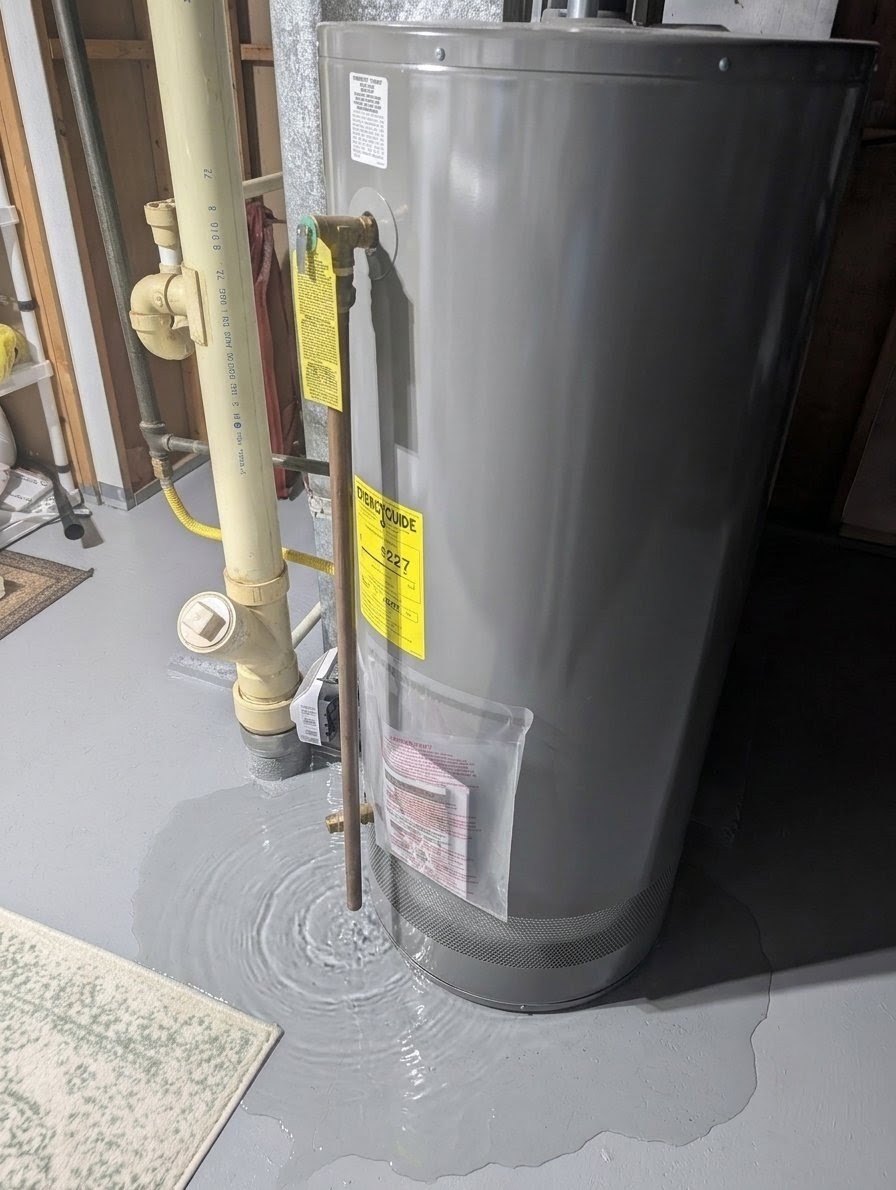
A real Triage Profile for this photo
- Reported
- “water on the floor around the water heater”
- What it is
- Gas water heater
- How urgent
- Emergency
- Who to call
- Plumber
A substantial pool of water around the base of the tank — an active, continuous leak.
Photo from a building we own. Read by fixRAgent on 30 Sep 2026; 3 of 3 independent reads agreed. Open this Triage Profile
Your first message to the tenant
Ask them to close the cold-water valve on the pipe entering the top of the heater (a lever handle turns a quarter-turn until it crosses the pipe; a round handle turns clockwise).
Electric heater: switch off its breaker — but not by standing in water to reach the panel. Gas: turn the control knob to “off” or “pilot”. If they smell gas: leave and call the gas company or 911 from outside.
Ask for one photo of the whole heater from the floor up, puddle in view — and a second of the top fittings if they can reach safely.
Towels or a wet-vac on the water; move boxes and anything electrical off the floor.
How urgent is it?
Water from a fitting on top, the drain valve, or the relief-valve pipe
Usually repairable: a plumber today. Water from the relief-valve pipe can mean the temperature or pressure is too high, or thermal expansion — have the plumber check the pressure too [1].
Water from under the tank with nothing else wet, or a rusted wet base
The tank has failed; it cannot be repaired. Plan a replacement — keep the water off until then.
Water coming through a ceiling below, or near the panel
Emergency: power off to the wet area, plumber now, and check the unit below.
Who to send
Plumber. For a replacement, check your local permit rules.
What to say to the tenant
“I’ve seen the photo. Please keep the water turned off at the valve on top of the heater and stay away from any wet outlets. I’m sending a plumber today and I’ll message you with a time.”
The Triage Profile writes this line for every photo, matched to how urgent it is.
What to record
- The tenant’s photo and the time it arrived.
- The heater’s label (make, model, serial — the serial encodes the manufacture date).
- What the plumber found and replaced, and whether the tank or a fitting failed.
Next time
Flush tanks and test relief valves on a schedule; makers recommend it as routine maintenance [2].
Sources
Got the tenant’s photo?
Drop it here. The Triage Profile says what it is, how urgent it is, who to send, and what to tell the tenant.