Repair guide
Breaker keeps tripping
Updated 30 Sep 2026 · AR Logic LLC · 1 source
Can be urgent — look for scorch marks
A breaker trips to stop a circuit overheating: it is either carrying more than it is rated for (too many things plugged in), or there is a short circuit or ground fault somewhere in a device or the wiring. Unplug everything on that circuit and reset it once; if it trips again with nothing plugged in, or you see scorch marks or smell burning, stop resetting it and call an electrician.
Is a breaker that keeps tripping an emergency?
It is an emergency if you see scorch marks, melted plastic or sparks, smell burning, or hear buzzing at the panel or an outlet: leave the breaker off and call an electrician now; if there is smoke or flame, get out and call 911. A breaker that trips only when the heater and the microwave run together is an overload, not an emergency.
Snap a photo — see what it is, how urgent, who to call.
One photo of the problem. fixRAgent reads it and gives you a Triage Profile.
Triage a photo nowNo sign-up.
Take the photo. We’ll tell you what it is.
No sign-up · AR Logic LLC · Privacy
Managing this for someone else? Managers: set it up for your buildings →
Managing this for someone else? There is a version of this for whole portfolios.
Managers: set it up for your buildings →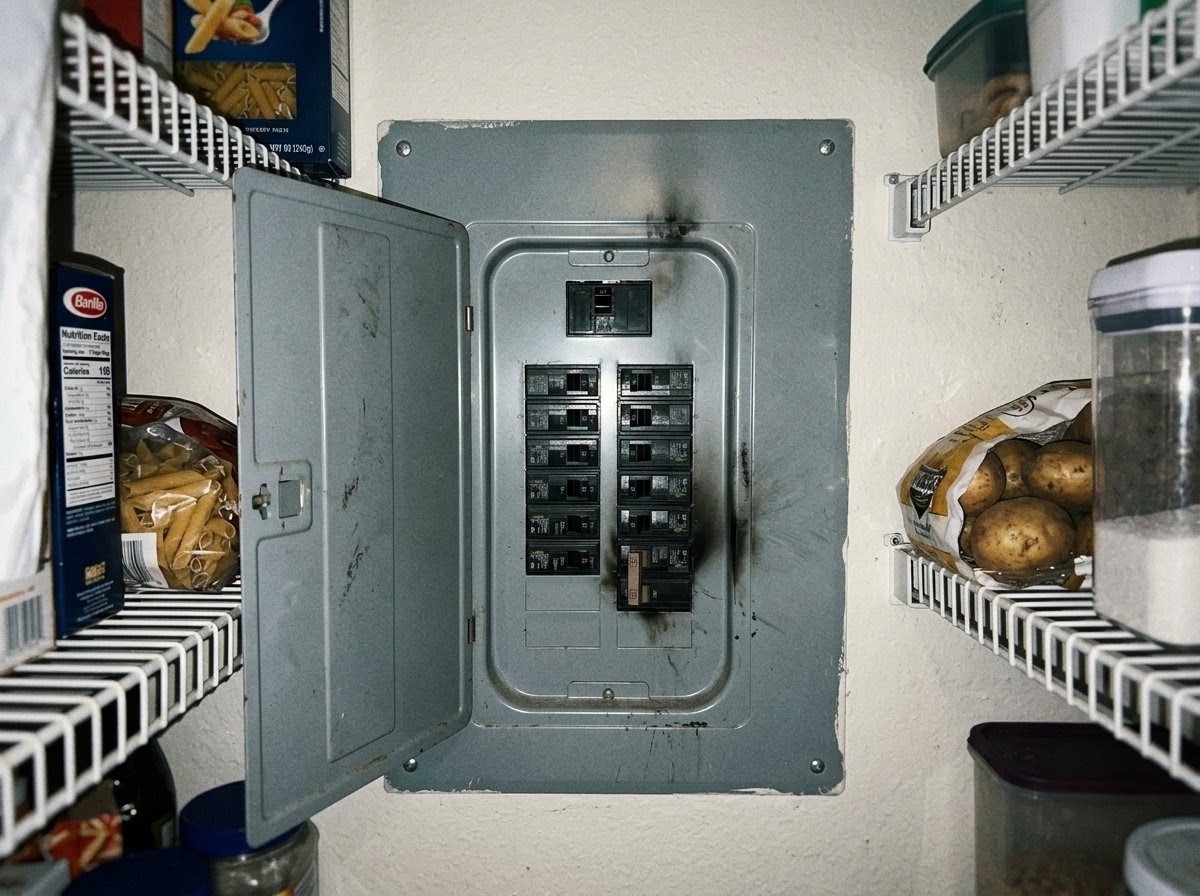
A real Triage Profile for this photo
- Reported
- “the same breaker keeps tripping”
- What it is
- Electrical panel
- How urgent
- Emergency
- Who to call
- Electrician
Soot and burn marks around the breakers — signs of arcing or a serious heat event inside the panel.
Photo from a building we own. Read by fixRAgent on 30 Sep 2026; 3 of 3 independent reads agreed. Open this Triage Profile
What to check, in order
Look before you reset
Open the panel door (not the cover) and look at the breakers. Soot, scorch marks or a burning smell mean stop: do not reset it.
Note what was running
If it tripped when a space heater, hair dryer, microwave or kettle came on, the circuit was overloaded. Move one of them to another circuit.
Unplug everything on the circuit, then reset once
Switch the breaker fully off, then on. Plug things back in one at a time; the one that trips it is the faulty device [1].
Trips with nothing plugged in
That points at a short or ground fault in the wiring, a switch or an outlet — an electrician’s job.
AFCI and GFCI breakers
Breakers with a test button are arc-fault (AFCI) or ground-fault (GFCI) types. They trip on faults a standard breaker would miss — a damaged cord, water in an outdoor outlet [1]. Their tripping is a warning, not a nuisance.
Safety first
- Never replace a breaker with a larger one to stop it tripping — the wire is sized for the breaker.
- Never remove the panel cover; live parts sit behind it.
- Keep hands dry and stand on a dry floor at the panel.
When to call a pro
Call a licensed electrician if it trips with nothing plugged in, trips at once on reset, or there is any sign of heat, scorch or buzzing.
What to photograph
For the Triage Profile, photograph the open panel door with the breakers and labels in view — never with the cover removed. One clear photo in good light is enough; the Triage Profile says what it is, how urgent it is (emergency, today, this week or whenever), and which trade to call.
Questions people ask
How many times can I reset a breaker?
Once, after unplugging the load. If it trips again, find the cause rather than resetting it again.
Can a breaker just wear out?
Yes, but an electrician should confirm it — a “weak breaker” is often a real overload or loose connection.
Sources
Not sure what you’re looking at?
Snap a photo of it. The Triage Profile says what it is, how urgent it is, and who to call.